The Future of Behind-the-Meter Power in the AI and Data Center Era

The AI buildout is not only a software race. It is an infrastructure and energy race. AI-optimized servers run at densities once reserved for heavy manufacturing and aluminum smelting, and the binding constraint on deployment is increasingly power, not chips.
As grid operators struggle to upgrade transmission fast enough for gigawatt-scale loads, hyperscalers and infrastructure developers are refusing to wait. To move quickly, they are turning to behind-the-meter power generation options and, in a growing number of cases, becoming their own utilities. This installment looks at where on-site power is heading and what it means for capital project engineering.
The Scale of AI Energy Demand
The numbers are stark. The IEA projects global data center electricity demand will roughly double to about 945 TWh by 2030, with AI-optimized demand more than quadrupling over the same window. Gartner projects that AI-optimized servers will account for 64% of the incremental power demand from data centers by 2030. Announced campuses are enormous: several U.S. developments are designed to scale into the multi-gigawatt range, with some single sites planned to reach roughly 10 GW, comparable to the peak demand of a major city.
Source: IEA, Energy and AI (2025); Gartner, Nov 2025; multi-GW campus scale per Utility Dive and Latitude Media reporting on announced projects (2025 to 2026).
The traditional utility path involves multi-year impact studies, regulatory approvals, and transmission construction. For developers targeting deployment inside 18 to 24 months, that is unworkable, so the solution is to generate power on-site and bypass the queue.
The Rise of the Off-Grid Data Center
On-site generation used to be supplemental. It is now primary for a growing share of new builds. A Cleanview analysis found that roughly one-third of currently planned data centers are behind the meter, and gas dominates that group despite renewable pledges. Bank of America reports that more than 7.5 GW of data center projects with on-site generation are already under construction, with another 60 GW-plus in pre-construction. Rather than going fully off-grid, many combine self-generation with a grid connection to improve reliability and shorten timelines.
Source: Cleanview, via E&E News / POLITICO (2026); Bank of America, via Utility Dive (2026).

Natural Gas as the Bridge
Right now the industry is seeing a surge in on-site gas plants. A Bloomberg New Energy Finance analysis identified about 100 GW of on-site gas-burning capacity planned to power U.S. data centers. Natural gas already accounts for roughly a quarter of the electricity consumed by data centers today. On-site gas lets developers sign long-term fuel contracts directly with suppliers and operate independently of state utility regulators. The trade-off is real: this approach swaps grid dependency for gas pipeline dependency and raises questions about local emissions and fuel-price exposure. A fast-growing share of this on-site gas is now consumed in non-combustion solid oxide fuel cells rather than turbines or engines, which delivers firm megawatt-scale power with far lower NOx and SOx and faster permitting.
Source: Bloomberg New Energy Finance, via Utility Dive / Facilities Dive (2026); gas share of data center electricity: IEA via Data Center Dynamics (2026).
The Transition to Zero-Carbon Firm Power
Because most large tech firms hold net-zero commitments, on-site gas is widely treated as a transitional strategy. The IEA expects renewables to meet roughly half of data center demand growth to 2035, supported by storage and firm dispatchable sources. The longer arc points toward firm, zero-carbon generation, and we expect faster deployment of:
Advanced fuel cells: powered by green hydrogen or green methanol, delivering baseload without combustion.
Small modular reactors (SMRs): next-generation nuclear designed to supply decades of carbon-free power to an industrial or data center campus.
Advanced geothermal: enhanced geothermal systems that provide firm, always-on renewable power in suitable regions.
Advanced microgrids: large BESS integrated with renewable arrays to target five-nines (99.999%) reliability without fossil fuels.
Source: IEA, Energy and AI (2025).
The Data Center Becomes Its Own Utility
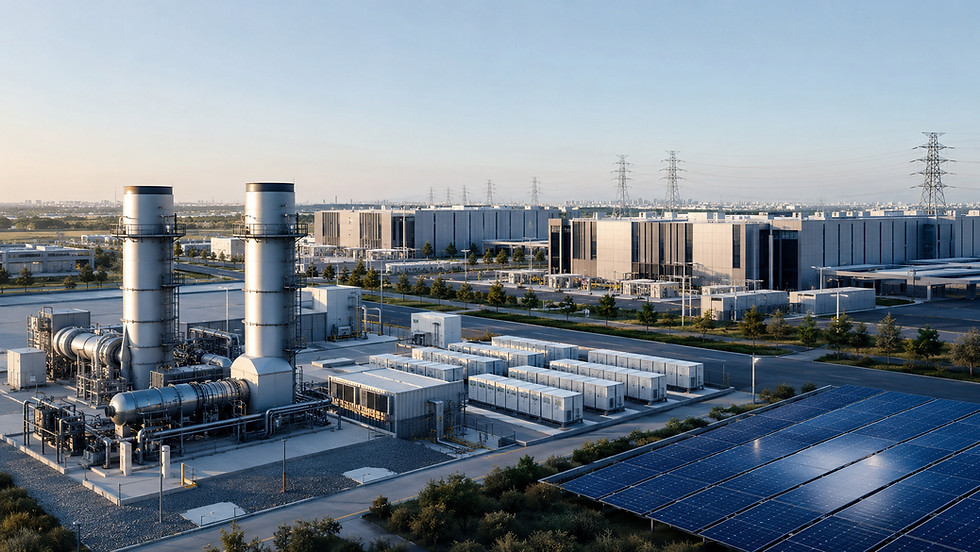
The defining shift of this era is that large loads are internalizing the generation function. When a developer signs a multi-gigawatt gas supply deal, builds on-site plants, and dispatches its own power, it is operating a private utility behind the meter. That changes the engineering scope: a modern AI data center project now requires FEED that blends data center architecture with utility-scale power plant engineering, from load studies and protection design to fuel logistics, water for cooling, and emissions permitting.
Navigating the New Regulatory Landscape
As data centers effectively become power plants, they enter a more complex regulatory environment. In June 2026, FERC issued Section 206 show cause orders directing all six RTOs and ISOs to justify or reform their large-load interconnection tariffs, following the DOE's October 2025 advance notice targeting loads of 20 MW and above. Policymakers are also scrutinizing how large off-grid gas consumption affects residential energy prices and how network upgrade costs should be allocated between large loads and other ratepayers. The line FERC draws between federal transmission authority and state retail jurisdiction will shape how off-grid and grid-parallel projects are structured.
Source: FERC show cause orders, June 18, 2026 (FERC; White & Case; McGuireWoods); DOE ANOPR, Oct 23, 2025.
Conclusion: Engineering the Future of Power
The AI era has made electricity the raw material of the digital economy. By integrating behind-the-meter power generation options, developers insulate their projects from grid delays and secure their operational future. Executing these hybrid systems takes deep capital-project engineering, from load studies and protection design to fuel logistics and permitting, and it is where the winners of the AI infrastructure race will be separated from the projects that stall.
Reach out to RVN Inc.'s engineering team to architect a power strategy that gets your facility online on time.
Frequently Asked Questions
Why is AI causing energy demand to spike?
AI accelerators (GPUs) draw far more power than standard cloud servers and generate intense heat, which adds further load for specialized liquid cooling.
What is an off-grid data center?
A facility that relies on its own behind-the-meter generation (such as an on-site gas plant or microgrid) for primary electricity, rather than drawing from the public grid.
How much on-site gas capacity is planned for US data centers?
A Bloomberg New Energy Finance analysis identified about 100 GW of planned on-site gas-burning capacity for U.S. data centers, with Texas leading the states.
Will natural gas power data centers forever?
Most operators treat gas as a bridge. They are investing in carbon-free options such as green hydrogen, advanced geothermal, and nuclear (including SMRs) to meet long-term ESG goals.
How do grid interconnection delays impact AI developers?
Multi-year waits can leave a finished data center without power, stranding capital and delaying revenue, which is why developers pursue on-site generation.
Are behind-the-meter data centers subject to utility regulations?
If they run fully off-grid and buy fuel directly, they largely fall outside state utility rate regulation, but they remain subject to environmental and air quality permitting and, increasingly, to FERC scrutiny of large-load interconnection.


Comments