Comparing Behind-the-Meter Power Generation Options: Natural Gas, Fuel Cells, Solar Plus Storage, and Microgrids

When a capital project requires tens or hundreds of megawatts of reliable electricity, leaning on an overburdened public grid is a liability. That is why engineering and infrastructure teams are actively evaluating behind-the-meter power generation options to secure energy independence, protect project timelines, and guarantee load reliability.
There is no one-size-fits-all answer. Selecting the right technology means weighing the facility's load profile, land availability, emissions targets, fuel access, and capital constraints. This guide compares the leading on-site power generation technologies, from natural gas and hydrogen powered fuel cells to solar plus storage and industrial microgrids.
How to Run a Behind-the-Meter Technology Screening
Before comparing technologies, define the site. A disciplined screening scores every option against the same factors, so the decision is driven by data rather than by a preferred solution.
Screening Factor | What It Determines |
Load profile & capacity factor | Whether you need firm 24/7 baseload or can flex with a variable source. |
Power quantity & growth | MW required today versus planned expansion; drives modularity and phasing. |
Fuel access | Firm gas pipeline capacity, hydrogen supply, or renewable resource on-site. |
Land availability | Rules solar in or out; land-constrained sites favor gas engines or fuel cells. |
Emissions & permitting | Air permit exposure (NOx, CO2), ESG targets, and carbon capture readiness. |
Capital vs operating cost | Low-capex, fuel-exposed gas versus high-capex, low-marginal-cost renewables. |
Speed to power | How fast the load must energize; often the deciding factor for AI and industrial builds. |
Reliability target | Uptime requirement (for example five-nines for data centers) and islanding needs. |
Behind-the-Meter Technology Comparison at a Glance
Technology | Speed to Power | Firmness / Baseload | Footprint | Emissions | Best Fit |
Reciprocating gas engines | Fast (months) | Firm, fast-ramping baseload | Moderate | CO2, NOx (air permit) | Rapid firm power; modular, phased build-outs |
Gas turbines / CCGT | Slower (turbine backlogs to 2030) | Firm baseload, high efficiency | Moderate | CO2, NOx (permit); CCS-ready | Large continuous loads with secured turbine slots |
Solar plus storage | Moderate | Intermittent; batteries shift load | Very high (land-intensive) | Zero at point of use | ESG targets, peak shaving, land-rich sites |
Fuel cells (natural gas or hydrogen, SOFC/PEM) | Fast (months) | Firm baseload; runs 24/7 on natural gas today | Small; high power density | Non-combustion: very low NOx/SOx; CO2 on natural gas, near-zero on green H2 | Fast, low-emission firm baseload; space or permit constrained sites; hydrogen-ready |
Microgrid (hybrid) | Varies by mix | Firm via orchestration and islanding | Varies | Optimized across sources | Resilience-critical sites; cost and emissions optimization |
Natural Gas Generation: The Speed-to-Power Champion
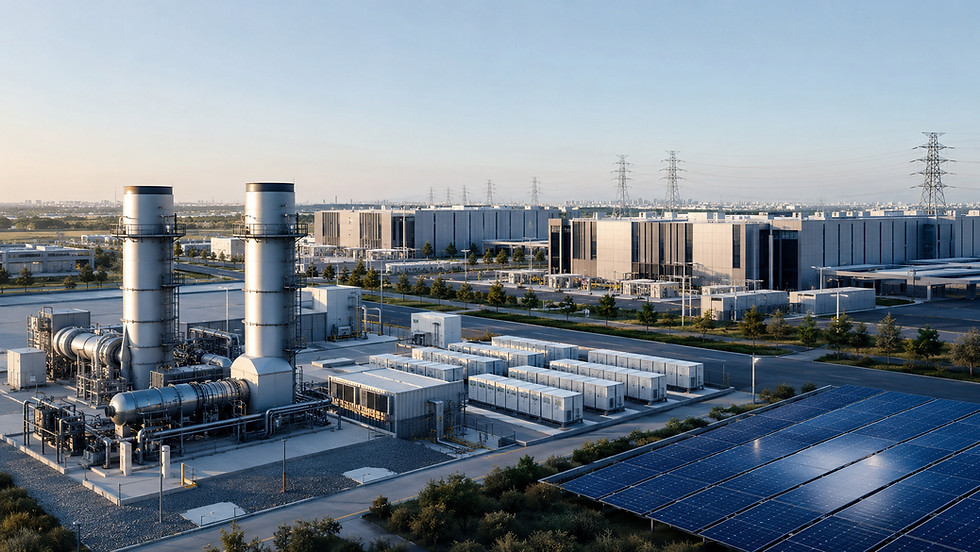
Natural gas generation, using combined-cycle gas turbines (CCGT) or reciprocating engines, is currently the workhorse of behind-the-meter power, especially for data center load. The two configurations serve different needs: CCGT delivers the highest efficiency for large, continuous baseload, while reciprocating engines offer modularity, fast ramping, and the quickest path to firm power on-site.
Advantages
Rapid deployment: gas systems, particularly reciprocating engines, can be permitted and installed far faster than a facility can wait for new high-voltage transmission.
Baseload reliability: gas delivers continuous, firm power that matches the flat, high-utilization load profiles of AI server farms and process plants.
Fuel economics: proximity to low-cost supply basins lets operators sign long-term fuel contracts and lock in a predictable cost stack.
Constraints
Emissions profile: combustion releases CO2 and NOx. Securing Clean Air Act air permits (PSD and Title V) takes time, and some sites will need to plan for post-combustion carbon capture.
Equipment lead times: surging demand has created global backlogs for large gas turbines, with manufacturer backlogs reported to stretch through 2030. Reciprocating engines are often the faster route to firm power.
Fuel and basis risk: firm pipeline capacity must be secured, and sites near producing basins can face basis differentials versus benchmark pricing.
Solar Plus Storage: The Low-Emission Option
Solar photovoltaic arrays paired with utility-scale battery storage are the benchmark for low-carbon distributed generation, and the pairing is what turns an intermittent resource into a partially dispatchable one.
Advantages
Zero emissions at the point of use: helps meet corporate ESG and net-zero commitments without air permitting for the generation itself.
Peak shaving: batteries discharge during peak utility pricing windows, cutting demand charges and overall energy spend.
Low marginal cost: once built, sunlight is free, so operating cost is dominated by maintenance rather than fuel.
Constraints
Energy density: solar is land-intensive. Powering a gigawatt-scale facility from solar alone requires thousands of acres, which is unworkable for many constrained sites.
Intermittency: even with large battery arrays, prolonged weather events threaten reliability without a firm backup source, so solar plus storage is often paired with gas or fuel cells for true baseload.
Fuel Cells: Firm Baseload Without Combustion, on Natural Gas or Hydrogen
Fuel cells convert fuel directly into electricity through an electrochemical reaction, without combustion. Solid oxide fuel cells (SOFC) and proton-exchange-membrane (PEM) designs differ in operating temperature and fuel tolerance. The point that matters for a capital project is fuel flexibility: the same platform can run on natural gas, biogas, or hydrogen. This is the technology behind the largest 2026 behind-the-meter deals, where solid oxide systems are being deployed at hundreds of megawatts, and in some projects into the gigawatts, to power AI data centers, most of them running on natural gas today with a pathway to hydrogen later. Because nothing is combusted, fuel cells emit very low NOx, SOx, and particulates, run quietly, and use little or no water, which shortens air permitting and eases community siting compared with engines and turbines.
Advantages
Clean and quiet: non-combustion operation means very low NOx, SOx, and particulate emissions and low noise, in a compact, high-density footprint that suits urban and space-constrained sites. On green hydrogen the system becomes zero-carbon.
Usable waste heat: captured heat can drive absorption chillers for facility cooling, improving overall combined heat and power efficiency.
Constraints
Fuel logistics: on natural gas the system still emits CO2 and carries fuel-price exposure, so it cuts criteria pollutants without being zero-carbon. The green hydrogen supply that would close that gap is still maturing, so the carbon benefit depends on the fuel pathway.
Storage and safety: running on natural gas needs firm pipeline capacity, while a hydrogen configuration adds on-site storage, handling, and safety engineering for compressed hydrogen.
Industrial Microgrids: The Hybrid Energy System
A microgrid is not a single source. It is a locally managed energy system that orchestrates multiple generation and storage assets under intelligent controls, sometimes coordinated by a distributed energy resource management system (DERMS).
Advantages
Resilience by design: a microgrid can island from the main grid during outages, holding critical load with minimal interruption.
Fuel and cost flexibility: controllers shift between solar when available, batteries during peak pricing, and gas for overnight baseload, optimizing for both cost and emissions.
Constraints
Engineering complexity: microgrids require rigorous FEED for protection, load-balancing, and synchronization, especially where the system must interoperate with the broader grid.
Capital and Operating Cost Logic
No option should be judged on upfront cost alone. Gas systems carry lower capital cost but fuel-exposed operating cost. Solar plus storage inverts that: higher capital cost, near-zero marginal cost once built. Fuel cells add both capital and fuel cost but buy a small footprint, non-combustion baseload, and fast deployment. Microgrids carry the highest integration cost but optimize lifecycle economics by dispatching the cheapest available source at any moment. The right lens is levelized cost of energy alongside the value of reliability and speed to power, not the sticker price of the equipment.
Permitting and Interconnection Constraints
Deployment speed is often decided by permitting, not procurement. Combustion options require air permits for NOx and CO2 and may trigger PSD or Title V review. Gas plants need firm pipeline capacity. Hydrogen storage introduces safety and siting requirements. Even grid-parallel behind-the-meter systems need an interconnection or islanding agreement with the utility and protection schemes to prevent unintended export. Folding these into the schedule at FEED is what separates a project that energizes on time from one that stalls.
Conclusion: Making the Right Engineering Choice
Choosing among behind-the-meter power generation options is a technical decision that shapes the lifecycle economics of the asset. Whether the priority is speed to power with natural gas or long-term decarbonization with fuel cells and renewables, rigorous technology screening is the first step. The right answer is site-specific, set by your load profile, land, fuel access, emissions targets, and how fast you need to energize.
Contact RVN Inc.'s capital project engineers to initiate a technology screening and feasibility study tailored to your site's load requirements.
Frequently Asked Questions
Which behind-the-meter option is the fastest to deploy?
In most jurisdictions, natural gas reciprocating engines are the fastest route to firm baseload power, typically faster than waiting for grid transmission upgrades.
Can solar power run a data center entirely?
It is very difficult. Data centers need constant baseload power, and solar requires vast land plus extensive storage to cover nighttime operation, so it usually serves as a supplementary source rather than the sole supply.
Are fuel cells a realistic option today?
Yes. Solid oxide fuel cells are being deployed at hundreds of megawatts to power AI data centers, running on natural gas today with a pathway to hydrogen. Because they do not combust fuel, they permit faster and site more easily than engines or turbines. The main constraints are natural gas price exposure and, for zero-carbon operation, the still-maturing green hydrogen supply.
How does a microgrid save money?
It uses smart controls to peak-shave, drawing on on-site batteries or solar when grid electricity is most expensive, which lowers overall operating cost.
What is the biggest risk with natural gas on-site generation?
Air permitting and fuel supply. Large gas plants face emissions scrutiny and must secure firm pipeline capacity, which carries price volatility.
How do I choose between a gas turbine and a reciprocating engine?
Turbines and CCGT win on efficiency for large continuous baseload; reciprocating engines win on speed, modularity, and fast ramping. Turbine lead times can also push developers toward engines.


Comments