Simple Cycle vs. Combined Cycle: A Decision-Maker's Guide to Maximizing ROI

Choosing the right technology for your natural gas power plant is the most consequential decision a project developer will make. Whether your facility needs to meet sudden spikes in peak grid demand or generate continuous, reliable electricity at maximum thermal efficiency, the choice between Simple Cycle vs. Combined Cycle power plant configurations dictates your upfront capital cost, physical footprint, operating cost and long-term profitability.
At RVN Inc., our engineering services teams specialize in guiding clients through this matrix of variables to ensure your infrastructure perfectly matches your operational goals. Below, we provide a deep dive into the engineering principles and strategic applications of both plant types.
The Simple Cycle Power Plant (SCPP): Agile Peaking Power
A Simple Cycle Power Plant (SCPP) represents gas turbine technology in its most direct form, operating entirely on the Brayton thermodynamic cycle. Ambient air is drawn into a multi-stage compressor, mixed with natural gas in a combustion chamber, and ignited. The high-temperature, high-velocity gas expands rapidly through the turbine blades, spinning a shaft connected to a generator.
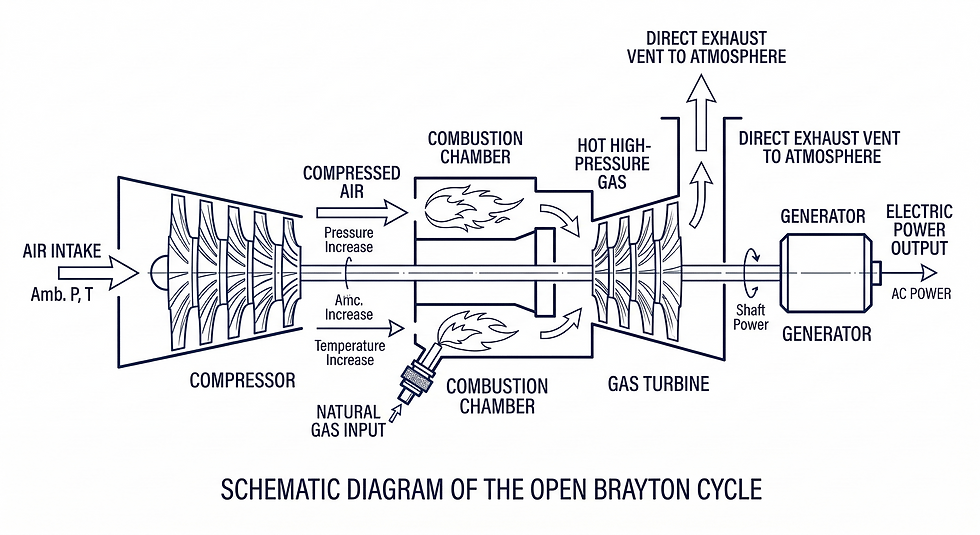
Once the gas expands and generates electricity, the remaining exhaust gas - often exceeding 500°C - is vented directly into the atmosphere through an exhaust stack.
Aero-Derivative vs. Heavy-Duty Frame: SCPP facilities often utilize aero-derivative turbines (derived from aviation engines). These are lighter, highly responsive, and capable of extremely fast ramp rates, making them ideal for grid stabilization. Heavy-duty frame turbines offer larger total megawatt output but sacrifice some start-up speed.
Rapid Deployment & Fast-Start Capabilities: SCPP units are the ultimate "Peaker plants." They can go from a cold, offline state to full generation loads in under 15 minutes. This agility is vital for providing emergency backup power and balancing intermittent renewable energy sources like wind and solar.
Drastically Lower Capital Expenditure (CapEx): Because a simple cycle plant lacks the massive secondary systems required to capture exhaust heat, the initial financial investment and physical footprint are significantly lower.
Maintenance & Cycling: Frequent starting and stopping (thermal cycling) causes wear and tear on turbine components. SCPPs are engineered to handle these thermal stresses better than baseload plants, though maintenance intervals are strictly tied to the number of "starts" the unit performs.
The Combined Cycle Power Plant (CCPP): Maximum Efficiency
While simple cycle plants excel at agility, venting 500°C exhaust gas into the sky represents a massive loss of potential revenue for any facility intended to run continuously. The Combined Cycle Power Plant (CCPP) solves this by combining the Brayton cycle (gas turbine) with a secondary Rankine cycle (steam turbine).

The heart of a CCPP is the Heat Recovery Steam Generator (HRSG). Instead of venting the gas turbine's exhaust, it is routed into the HRSG, acting as a colossal heat exchanger. The exhaust heat boils highly purified water, creating high-pressure, superheated steam that drives a dedicated steam turbine connected to a secondary generator.
Unprecedented Thermal Efficiency: By extracting two separate streams of electricity from a single stream of natural gas, CCPPs push thermal efficiency to extraordinary levels. While SCPP efficiency hovers around 30% to 40%, CCPPs frequently exceed 60%, with the newest generation of "H-class" turbines pushing toward 65%.
Advanced HRSG Configurations: Modern CCPPs use multi-pressure HRSGs (dual or triple pressure) with reheat cycles to extract every possible joule of thermal energy from the exhaust stream, maximizing the steam turbine's output.
Lowest Levelized Cost of Energy (LCOE): While the initial CapEx of a CCPP is substantially higher, fuel costs account for the vast majority of a power plant's lifetime operating expenses. The dramatic fuel savings achieved by a CCPP make it the most economical choice for baseload power generation over a 20-to-30-year lifecycle.
Cooling Systems & Water Demand: Unlike simple cycle plants, the steam cycle in a CCPP requires a condenser to turn the steam back into water. This necessitates massive cooling infrastructure (wet cooling towers or air-cooled condensers), which dramatically increases the plant's footprint and water consumption.

(Note: If your facility is exploring advanced fuel configurations or integrating syngas processes alongside natural gas, read our technical breakdown of Fischer-Tropsch Synthesis to understand the chemical integration.)
Making the Strategic Choice
The most successful power generation assets are never built from a universal template. They are engineered to meet the exact demands of their operating environment.
At RVN Inc., we align technology selection directly with your financial targets. By evaluating your specific dispatch profile and market variables, our engineering team customizes a plant design that balances initial investment with lifetime efficiency.
Your next energy infrastructure project requires specialized precision to succeed. We deliver the engineering solutions necessary to secure your long-term profitability.
Reach out to our engineering leadership team directly via our contact page to discuss your specific project parameters.
About Author: Ragavan Vaidyanathan is a Chemical Engineer (Ph.D., Auburn University) with 25+ years leading capital projects up to $3B TIC across Power, Petrochemical, Refining, and Renewable Fuels. Former Sr. Director of Process Engineering at Jacobs/Worley, he now leads RVN Inc., delivering high-value engineering solutions from Houston, TX. About RVN: RVN Inc. is a Houston-based engineering firm specializing in pre-FEED, FEED, detailed engineering, and AACE Class 3 cost estimation for capital projects across the Power, Petrochemical, Polymer, Refining, and Renewable Fuels industries. With a global network of high-value engineering centers, RVN delivers rigorous technical execution — from process design through commissioning — for clients navigating complex, large-scale energy transitions including Sustainable Aviation Fuel. 📩 To learn more or discuss your SAF project, contact us at admin@rvninc.com |


Comments