HEFA SAF Engineering in 2026: Is Used Cooking Oil Still the Right Bet?
A data-driven look at HEFA feedstock economics, production cost, CAPEX, and when the world's dominant SAF pathway still makes sense for new plant projects

Key Takeaway
HEFA is the lowest cost and most commercially mature SAF engineering pathway available in 2026. However, used cooking oil supply constraints mean it cannot scale past a fraction of total SAF demand by 2030. For new projects starting today, HEFA works if you can secure feedstock. Without a committed, traceable supply contract, the economics break down.
What Is HEFA and Why Does It Dominate SAF Engineering Production?
Hydroprocessed esters and fatty acids, commonly called HEFA, is the production pathway behind more than 95 percent of global SAF output today. The technology has been used in renewable diesel production for over a decade. Converting that existing industrial experience to produce jet fuel required relatively modest changes to the refinery process, which is why HEFA reached commercial scale faster than any other SAF pathway.
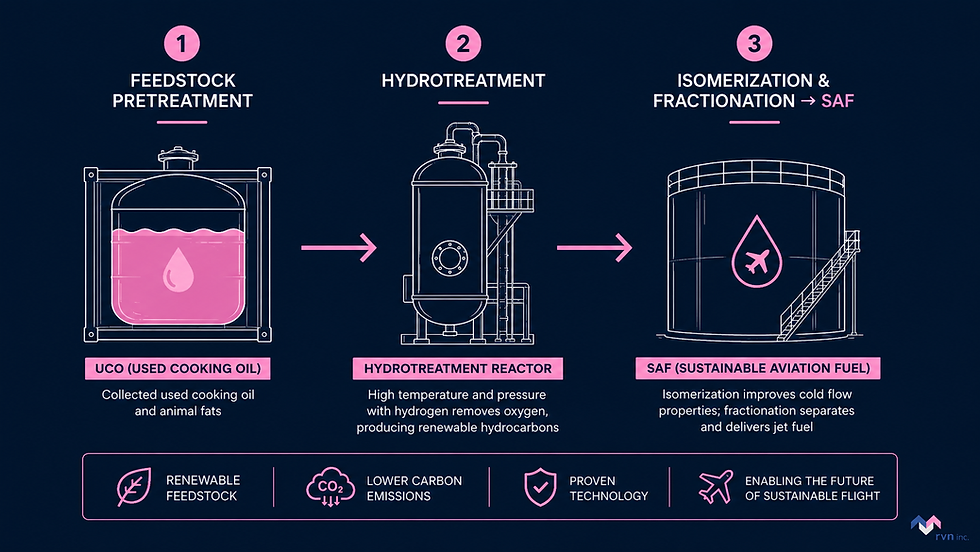
The basic chemistry involves three steps. Lipid feedstocks such as used cooking oil, animal fats, and vegetable oils are pretreated to remove water, free fatty acids, and contaminants. The pretreated oil is then hydrotreated, which uses hydrogen to strip oxygen from the fatty acid chains and produce paraffinic hydrocarbons. Finally, those hydrocarbons are isomerized and fractionated to produce SAF that meets ASTM D7566 Annex A2 specifications.
HEFA Feedstock: The Core Economics and the Core Risk
Feedstock cost is the defining variable in HEFA project economics. In a typical HEFA plant, feedstock accounts for 50 to 70 percent of total production cost. Unlike most petrochemical processes where feedstock is a commodity with liquid markets, HEFA feedstocks are competing with other industries and are geographically constrained.
750 - 1,250 | USD per tonne. UCO bulk price range across Europe and North America in 2025 and 2026. Source: Fastmarkets. |
3-8% | Share of projected 2030 global SAF demand that collectable UCO can supply. Source: Energy Solutions, Transport and Environment. |
50-70% | Share of total HEFA production cost typically attributable to feedstock. Source: OIES, December 2025. |
Used cooking oil prices have climbed steadily because demand from HEFA plants, renewable diesel producers, and the animal feed industry now exceeds collectable supply in most western markets. Transport and Environment analysis from March 2026 found that European and US UCO demand is already unsustainable at current volumes, before accounting for any planned capacity expansions.
The practical implication for plant owners is straightforward. A HEFA plant without a minimum five-year feedstock supply agreement at a committed price is not a financeable project. Lenders and equity investors require traceable supply contracts before moving to final investment decision.
Parameter | Typical Range | Notes |
CAPEX per tonne SAF capacity | 500 to 900 USD/tonne/year | Lower end for revamp of existing hydrotreater; higher for greenfield |
Production cost | 1.30 to 1.70 USD/kg SAF | Source: OIES December 2025; includes feedstock at 900 USD/tonne UCO |
Production cost in USD/gallon | 4 to 5 USD/gallon SAF | Compared to 0.80 to 1.20 USD/gallon for conventional jet fuel |
Hydrogen consumption | 250 to 350 kg H2 per tonne SAF | Major utility cost driver; hydrogen source location matters |
SAF yield from feedstock | Around 71 percent | Balance goes to renewable diesel and naphtha co-products |
Typical FEED duration | 6 to 9 months | Shorter for brownfield revamp with existing H2 supply |
When does HEFA still make sense in 2026?
Feedstock cost is the defining variable in HEFA project economics. In a typical HEFA plant, feedstock accounts for 50 to 70 percent of total production cost. Unlike most petrochemical processes where feedstock is a commodity with liquid markets, HEFA feedstocks are competing with other industries and are geographically constrained.
Scenario 1: You have traceable feedstock supply
If you operate or have equity in a UCO collection business, rendering plant, or animal fat supply chain, HEFA is the fastest pathway to first production. The technology is commercially proven, the FEED timeline is the shortest of all four pathways, and existing refinery hydrotreaters can often be revamped rather than built from scratch.
Scenario 2: You are retrofitting an existing refinery
Gulf Coast refineries with underutilized hydrotreating capacity and access to hydrogen from an existing hydrogen plant or steam methane reformer have the lowest capital cost entry point into SAF production. An existing hydrotreater can often be qualified for HEFA feedstock processing with modifications in the 30 to 100 million US dollar range, versus several hundred million for a greenfield plant.
Scenario 3: You need first revenue before moving to a second pathway
Some developers use HEFA as a phase one strategy: get a plant running on UCO to generate offtake contracts and operating history, then expand into ATJ or Fischer-Tropsch in a phase two. The operational credibility from phase one helps significantly with phase two financing.
When HEFA is the wrong choice?
You do not have committed feedstock. If feedstock sourcing is still open at the time of pre-FEED, the economics are too uncertain to justify FEED investment.
Your project timeline runs past 2028. Feedstock scarcity will only worsen. A project that starts on UCO today but has no alternative feedstock strategy is taking on increasing risk year by year.
Your site has no existing hydrogen supply. Hydrogen sourcing is the second largest cost driver after feedstock, and a greenfield hydrogen plant adds significant CAPEX.
Your target market is in the EU under ReFuelEU. Imported UCO is increasingly scrutinized under EU traceability rules. European projects need domestically sourced or certified traceable feedstock to qualify for mandate credits.
What the HEFA FEED scope typically covers?
A standard HEFA pre-FEED typically includes a feedstock assessment and supply risk evaluation, basic process simulation, heat and material balance, utility integration study, equipment list, and an AACE Class 4 cost estimate. The FEED phase expands this into a full process basis, piping and instrumentation diagrams, equipment specifications, plot plan, and an AACE Class 3 cost estimate suitable for lender review.
RVN provides HEFA FEED and pre-FEED services from our Houston, Texas office. Our refinery process engineering experience applies directly to HEFA hydrotreater design and revamp scope.
Frequently Asked Questions
Can a diesel hydrotreater be converted to process HEFA feedstock?
Yes, in many cases. Existing hydrotreating units can be qualified for renewable feedstocks with modifications to the feed pretreatment section, heat integration, and sometimes the reactor internals. The feasibility depends on the unit's hydrogen pressure rating, catalyst type, and current throughput. A pre-FEED study typically takes 8 to 12 weeks to assess conversion potential.
What is the minimum economic scale for a HEFA SAF plant?
Most standalone HEFA SAF plants are designed for 50,000 to 300,000 tonnes per year of SAF output. Below 50,000 tonnes, the capital cost per unit of output becomes difficult to justify without co-products or feedstock cost advantages. Co-located projects that share utilities with an existing refinery can operate at smaller scales.
How long does HEFA SAF feedstock pretreatment take?
Feedstock pretreatment is a continuous operation and is sized to match the main hydroprocessing unit. The pretreatment section typically handles degumming, drying, and free fatty acid removal. Capital cost for the pretreatment section is usually 10 to 20 percent of total plant CAPEX.
About Author: Ragavan Vaidyanathan is a Chemical Engineer (Ph.D., Auburn University) with 25+ years leading capital projects up to $3B TIC across Power, Petrochemical, Refining, and Renewable Fuels. Former Sr. Director of Process Engineering at Jacobs/Worley, he now leads RVN Inc., delivering high-value engineering solutions from Houston, TX. About RVN: RVN Inc. is a Houston-based engineering firm specializing in pre-FEED, FEED, detailed engineering, and AACE Class 3 cost estimation for capital projects across the Power, Petrochemical, Polymer, Refining, and Renewable Fuels industries. With a global network of high-value engineering centers, RVN delivers rigorous technical execution — from process design through commissioning — for clients navigating complex, large-scale energy transitions including Sustainable Aviation Fuel. 📩 To learn more or discuss your SAF project, contact us at admin@rvninc.com |
Sources
OIES. Drop In Decarbonization: Techno-Economic Benchmark for SAF. December 2025.
Fastmarkets. Used Cooking Oil Price Forecast for SAF. December 2025. fastmarkets.com
Transport and Environment. European and US UCO demand increasingly unsustainable. March 2026. transportenvironment.org
Energy Solutions. UCO Market 2026. energy-solutions.co
IATA. SAF Handbook. May 2024. iata.org


Comments